
Casino Strategy

How Casino Odds Are Calculated Across Popular Casino Games

Why does a roulette number pay 35:1 while a baccarat Banker bet pays less than

Read More

How Casino Odds Are Calculated Across Popular Casino Games
Casino Games

How Casino Games Have Evolved Through Live Dealers and Digital Tech

Casino innovation used to mean introducing a new table variation or building a more impressive

Read More
How Casino Games Have Evolved Through Live Dealers and Digital Tech
Casino Bonuses

Common Casino Bonus Mistakes: Read the Offer Before You Claim

A $500 casino bonus can look much better than a $50 offer when the two

Read More
Common Casino Bonus Mistakes: Read the Offer Before You Claim
Casino Strategy

How Casino Odds Are Calculated Across Popular Casino Games

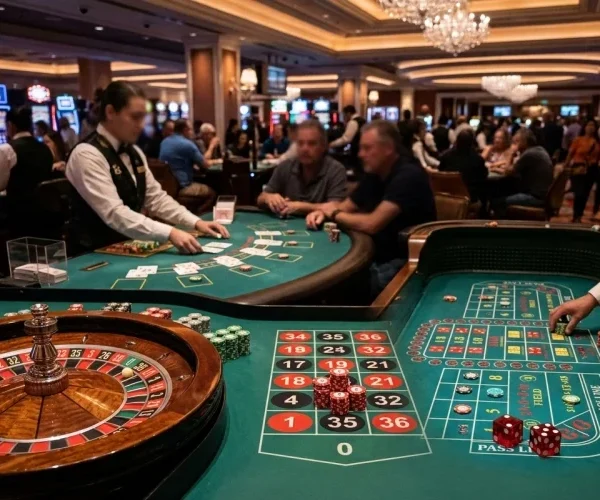
Why does a roulette number pay 35:1 while a baccarat Banker bet pays less than even money after commission? Why can a slot advertise 96% RTP while a craps wager has its own house-edge percentage?

The answer is mathematics, but each game reaches those numbers differently. This guide explains How Casino Odds Are Calculated across several familiar games.

Instead of treating odds as one universal formula, we will look at how wheels, cards, dice, paytables, and software create different probability models – and why apparently similar wagers can have very different long-term costs.

Roulette Starts With the Number of Pockets

Roulette offers one of the clearest examples of casino probability.

A double-zero American wheel contains 38 possible pockets: 1 through 36, 0, and 00.

Suppose you wager on red. There are 18 red numbers, so the probability of winning is:

18 ÷ 38 = 47.37%

The bet pays 1:1.

If the game contained only 36 red and black numbers, an even-money payout would be mathematically balanced. The two green zero pockets change that equation.

When either 0 or 00 appears, the normal red and black bets lose. That creates the standard 5.26% house edge on double-zero roulette.

Single-zero roulette has only 37 pockets. With one green zero instead of two, the standard house edge falls to about 2.70%.

The lesson is simple: adding or removing one pocket changes the odds even though the table looks almost identical.

Blackjack Odds Depend on Rules and Decisions

Blackjack cannot be calculated with one simple fraction because the probability changes as cards are removed from the deck.

Player decisions matter as well.

Consider a hand of 11 against a dealer’s 6. The expected value of hitting, doubling, or taking another action is determined by the composition of remaining cards, dealer rules, and payout structure.

Rule variations also affect the overall house advantage.

Wizard of Odds’ blackjack calculator includes variables such as number of decks, whether the dealer hits or stands on soft 17, doubling after splits, surrender, resplitting, and whether blackjack pays 3:2 or 6:5.

This is why a statement such as “blackjack has a 0.5% house edge” is incomplete without mentioning rules and strategy.

Under one rule set, optimal basic strategy may produce an edge near that range. Change the blackjack payout or several table rules and the calculation changes.

The mathematics is therefore conditional rather than fixed.

Craps Begins With 36 Dice Combinations

Two six-sided dice produce 36 ordered outcomes.

Some totals appear much more often than others.

A 2 can only happen as 1+1, so it has one combination. A total of 6 has five combinations. A 7 has six and is therefore the most common total.

From there, each craps wager can be analyzed according to its win conditions and payout.

Consider an Any Craps wager covering totals 2, 3, or 12. There are four winning combinations out of 36, creating an 11.11% chance of winning.

At a standard 7:1 payout, Wizard of Odds calculates a house edge of 11.11%.

Meanwhile, a Place 6 bet has a very different structure. It wins when 6 appears before 7, so the relevant comparison is five combinations for 6 against six for 7. The usual 7:6 payout creates a house edge of about 1.52% per resolved wager.

Same dice, very diffrent mathematics.

Baccarat Requires Counting Card Combinations

Baccarat looks simple because most players choose among Banker, Player, and Tie.

Calculating the probabilities behind those wagers is much more involved.

Cards can produce many possible hand sequences under baccarat’s fixed drawing rules. Analysts therefore calculate the frequency of each final outcome across all relevant combinations.

For a standard eight-deck game, Wizard of Odds calculates approximately:

Banker wins: 45.86%
Player wins: 44.62%
Tie: 9.52%

Because a standard Banker win pays 0.95:1 after the usual 5% commission, its house edge is approximately 1.06%. The Player bet has an edge of about 1.24%.

The common Tie bet illustrates why payout alone can be misleading.

A traditional 8:1 Tie payment sounds much larger than the main wagers, yet Wizard of Odds calculates a house edge around 14.36% on that paytable.

A large payout often exists because the event itself is less frequent.

Slot Odds Come From Reel Mathematics and Paytables

Modern slots work differently from physical wheels and dice games.

Their theoretical return is determined by the probability assigned to possible outcomes and the amount each winning combination pays.

A simple hypothetical slot might have a 10% chance of paying 2x, a 1% chance of paying 20x, and many losing outcomes. Developers can combine all those probabilities and payouts to calculate theoretical RTP.

In modern digital games, the visible reels do not necessarily tell you the true frequency of every symbol. Software and virtual reel structures can allow different symbols or combinations to have different underlying probabilities.

The UK Gambling Commission requires relevant gaming machines in Great Britain to display their theoretical target RTP, and certain machine categories have that value verified by the manufacturer or an accredited test house.

If the designed RTP is 96%, the theoretical difference of 4% represents the long-term amount not returned to players, although actual results can vary substantially during short sessions.

That variation is often described through volatility.

RTP and House Edge Are Closely Related

RTP and house edge often express the same underlying mathematical relationship from opposite viewpoints.

If a game returns a theoretical 97% of stakes over the long run, the corresponding house advantage is roughly 3%, provided both figures are calculated on a comparable basis.

So:

RTP ≈ 100% − House Edge

A 96% RTP corresponds approximately to a 4% edge.

But care is needed when making comparisons.

Wizard of Odds notes that house edge is conventionally based on the initial wager, which can become tricky in games where additional money may enter play later.

Craps creates another complication because some bets can remain unresolved across several rolls. Wizard of Odds therefore provides house-edge figures per bet made, per bet resolved, and per roll for certain wagers.

The numbers only make sense when you know exactly how they were defined.

Why a 10:1 Payout Does Not Mean a 1-in-10 Chance

Payout language can easily create misunderstandings.

If something pays 10:1, that does not automatically mean it happens once in every 10 attempts.

A fair 10:1 payout would correspond to odds against the event of 10 to 1, meaning one winning outcome for every ten losing outcomes. That is a probability of:

1 ÷ 11 = 9.09%

Notice the denominator is 11, not 10.

A casino may also offer a payout below the true odds. If an event with fair odds of 10:1 pays only 8:1, the difference contributes to the house advantage.

This is why payout ratios and probability should always be considered together.

Looking at either number alone gives an incomplete comparision.

House Edge Does Not Tell You Session Volatility

Imagine two games that both have a 3% theoretical house edge.

One might produce frequent small wins and losses. The other could generate long losing periods interrupted by rare large payouts.

Their expected long-term loss rate may be similar, but the experience can feel completely different.

That difference is related to variance or volatility.

The UK Gambling Commission explains that actual RTP can move above or below theoretical RTP over shorter samples, with volatility affecting the acceptable range of variation. As play volume grows, actual results should generally move closer toward the designed theoretical return.

So house edge answers one question: what is the expected long-run mathematical advantage?

Volatility answers another: how unevenly might results arrive?

Confusing the two can make a high-volatility game seem “worse” simply because short-term swings are larger.

Odds Describe the Game, Not the Next Outcome

Even perfectly calculated casino odds cannot predict an individual result.

If a double-zero roulette wheel gives red a probability of 18/38, that probability does not mean a red result must arrive after several black spins.

Likewise, an RTP of 96% does not mean a slot must return $96 after exactly $100 of play.

The UK Gambling Commission states that on random gaming machines, the odds of winning the current game remain constant and are not affected by previous wins or losses.

Probabilities describe repeated outcomes across large samples.

They are extremely useful for comparing games, understanding payout structures, and calculating expected value – but they are not a timetable for future wins.

Learning How Casino Odds Are Calculated shows why every game needs its own mathematical model.

Roulette uses wheel pockets, craps uses dice combinations, baccarat and blackjack involve card probabilities, while slots combine programmed outcome frequencies with paytables.

Before comparing two wagers, look at both the chance of winning and the payout offered. House edge and RTP can then show how those numbers translate into long-term expected value.

Casino Games

How Casino Games Have Evolved Through Live Dealers and Digital Tech

Casino innovation used to mean introducing a new table variation or building a more impressive slot cabinet.

Today, developers can mix real dealers, digital interfaces, Random Number Generators, augmented reality, multi-camera streaming, and interactive bonus games inside one product.

That shift helps explain How Casino Games Have Evolved from relatively simple digital copies into a much broader form of interactive entertainment.

Modern technology has not only changed where casino games are available. It has also changed their speed, visual design, audience size, and the kinds of mechanics developers can create.

Online Casinos First Recreated Familiar Games

Early digital casino design had an obvious challenge: convince players that familiar games could work without physical casino equipment in front of them.

The early commercial Web developed rapidly during the 1990s. The Computer History Museum notes that gambling websites were among the first types of businesses generating substantial online revenue by around 1995.

Early games naturally borrowed heavily from physical casinos.

Digital roulette still looked like roulette. Blackjack showed virtual cards and a dealer area. Online slots imitated reels even though there was no longer a mechanical reason to use them.

This approach made new technology easier to understand.

Instead of teaching an entirely new game, developers changed the delivery method while preserving familiar rules.

RNG Allowed Games to Move Beyond Physical Limits

Random Number Generator technology helped casino software become more independent from physical equipment.

A digital result no longer needed a physical reel to stop or a dealer to draw a card. Software could generate outcomes according to the mathematical rules of the game and display the result through graphics.

That flexibility transformed game design.

Slots could add dozens of paylines, unusual reel configurations, animated features, cascading symbols, random modifiers, and complicated bonus rounds.

RNG products also became subject to technical regulation in licensed markets. Great Britain’s current Remote Gambling and Software Technical Standards set requirements for remote gambling software offered by licensed operators.

This regulatory layer became increasingly important as the games themselves became more technically complecated.

Live Casino Reconnected Digital Gaming With Real People

RNG solved many technical problems, but it could not fully reproduce the atmosphere of watching a dealer shuffle cards or seeing a real roulette wheel spin.

Streaming technology created another direction.

Evolution launched its first live casino operation from Riga in 2006. The early studio had only a handful of tables, basic cameras, and comparatively limited streaming technology.

Players could watch real casino action through their computers rather than relying entirely on digital animation. The concept grew alongside broadband internet.

By 2016, Evolution reported more than 150 live tables and more than 2,000 employees after beginning with a small studio ten years earlier.

Modern live casino studios now use professional lighting, several camera angles, dedicated hosts, detailed interfaces, and much higher-quality streams.

The underlying blackjack or baccarat rules may be old, but the production resembles broadcasting.

Smartphones Changed the Design Philosophy

Desktop online casinos could use wide interfaces filled with menus, statistics, and betting controls.

Phones changed that.

Evolution began extending its live product onto tablets in 2012, bringing games such as Live Roulette to the iPad and planning mobile versions of blackjack and baccarat soon after.

As smartphones became the primary internet device for many people, developers had to design games around touch controls and smaller displays.

Menus became more compact. Bet buttons became larger. Game histories, rules, live video, and betting areas had to share limited screen space.

This affected slots too.

Instead of creating a desktop game and shrinking it later, many modern titles are designed to feel natural on mobile from the beginning.

That is a major shift from the old casino model, where the hardware dictated the size of the game.

Live Tables Learned to Scale Beyond Physical Seats

A physical blackjack table has an obvious limitation: only so many chairs fit around it.

Online technology does not have the same problem.

Modern live casino systems can allow large numbers of people to participate in a single streamed game while software manages individual wagers. Other formats can give players shared starting conditions before letting each participant make seperate decisions.

The UK Gambling Commission’s definition of remote gambling reflects this broader technological model, covering gambling through the internet, phones, television, radio, and other electronic communication systems.

The table no longer needs to be a physical place that every participant can touch.

It can instead function as a live event delivered simultaneously to screens in many locations.

That change is especially important because it shows how digital technology did more than recreate casinos – it removed some of their physical constraints.

Game Shows Blurred the Line Between Casino and Entertainment

One of the biggest modern changes has been the rise of live casino game shows.

Evolution’s Dream Catcher launched in 2017 as a large money-wheel game and helped establish the provider’s live game-show category.

Crazy Time pushed the idea further in 2020.

Its format combines a physical money wheel with multiple bonus games, RNG-generated multipliers, augmented reality, and design ideas borrowed from slot games and video games.

This is very diffrent from simply streaming a traditional blackjack table.

The studio itself becomes part television set, part casino floor, and part interactive digital interface.

Today’s live game-show category demonstrates how far casino design has moved from merely digitizing old games. Developers can now create experiences that would be difficult to classify as purely slot, table game, or television show.

Technology Also Changed What Players Can See

Older casino players had access to what was physically displayed around them.

Digital interfaces can present far more information.

Modern games may show previous results, payout tables, live statistics, betting histories, countdown timers, side-bet explanations, and animated indicators. Players can often open complete game rules without leaving the table.

Live casino broadcasts can also switch between multiple cameras.

A roulette stream might move from a wide studio shot to a close view of the wheel. Game shows can combine real presenters with augmented-reality graphics that appear directly inside the broadcast.

This does not change probability by itself, but it changes how information and entertainment are presented.

Casino games increasingly compete not just through rules but through user-interface design and production quality.

The Modern Casino Is Becoming a Hybrid Platform

One of the clearest trends is that boundaries between game categories are becoming less rigid.

Evolution now describes its portfolio as including traditional live casino, live game shows, RNG First Person table games, and slots. Its First Person products, for example, use RNG gameplay while visually resembling live environments, with some versions allowing users to switch into a live table.

Meanwhile, game shows combine live hosts with computer-generated multipliers.

Roulette variations can add RNG features. Slots borrow cinematic storytelling. Blackjack variants can introduce multipliers or other modifiers.

The modern casino is therefore less about choosing between “physical” and “digital.”

Those two worlds increasingly overlap.

What Has Not Changed?

Despite decades of technical innovation, the basic appeal of many games remains recognizable.

Cards still create blackjack hands. A roulette result still comes down to a numbered outcome. Slots still resolve wagers through symbol combinations or equivalent game events.

Technology mainly changes access, speed, presentation, and the number of possible features.

This explains why a game invented long before smartphones can still feel comfortable inside a modern mobile interface.

The surface evolves quickly. The foundation changes much more slowly.

Understanding How Casino Games Have Evolved means looking beyond better graphics. The bigger changes came from RNG software, internet distribution, mobile interfaces, live video, scalable tables, and interactive game-show technology.

Modern casino games increasingly combine physical and digital ideas rather than choosing one or the other. Watch how those mechanics interact, and you can see exactly where traditional casino design ends and modern interactive entertainment begins.

Casino Bonuses

Common Casino Bonus Mistakes: Read the Offer Before You Claim

A $500 casino bonus can look much better than a $50 offer when the two are sitting next to each other on a promotion page. But headline numbers rarely tell the whole story.

One promotion may be easy to understand, while another comes with several conditions affecting how and when its value can actually be used.

This guide covers Common Casino Bonus Mistakes from a different angle: evaluating an offer before opting in.

Instead of chasing the biggest number, you will learn how to compare the real requirements behind casino bonuses and recognize details that deserve attention.

Mistake One: Comparing Bonuses Only by Size

Marketing naturally puts the biggest number where you can see it.

“200% bonus,” “100 free spins,” or “up to $1,000” sounds much more exciting than a long paragraph explaining qualification rules.

Yet those smaller details determine what the promotion really offers.

Imagine Casino A provides a $100 bonus with straightforward conditions. Casino B advertises $500, but you need a much larger deposit to receive the maximum and the promotion has stricter game or time restrictions.

Casino B has the bigger headline. That does not automatically make it the more practical promotion.

UK advertising rules require significant promotional conditions that could affect a consumer’s decision to be stated clearly and prominently. These can include deposit requirements, eligibility limitations, wagering conditions, and deadlines.

When comparing offers, start with the conditions rather than the maximum advertised amount.

Mistake Two: Not Calculating the Real Wagering Target

Wagering requirements become much easier to understand when converted into an actual number.

Suppose a casino awards a $60 promotional balance and applies a 10x requirement to that bonus amount.

The calculation is:

$60 × 10 = $600

Now you have something concrete to evaluate.

However, never assume every promotion uses the same formula. Read what amount the multiplier applies to and how qualifying play is counted.

Current rules for operators licensed in Great Britain prohibit wagering requirements above 10 times bonus funds for covered incentives. That cap became effective on January 19, 2026.

This is a jurisdiction-specific example, not a worldwide standard.

If you are using a service regulated somewhere else, the allowable terms and promotion structure may be different.

Mistake Three: Assuming Every Game Counts the Same

Completing a wagering requirement is not always as simple as wagering the target amount on whichever game you prefer.

Game contribution percentages can change the calculaton.

For example, imagine the remaining requirement is $300.

If your selected slot contributes 100%, wagering $100 counts as $100 of progress. If a blackjack game contributes only 10%, the same $100 of wagers would contribute only $10.

Some games may contribute nothing at all.

The Gambling Commission notes that significant terms can include the fact that certain games do not qualify or that contribution rates vary between games.

Always check the eligible-games section before playing.

Otherwise, you could spend a long session on a game you enjoy only to discover that almost none of the activity advanced the bonus requirement.

Mistake Four: Ignoring Payment Method Restrictions

The deposit itself can also affect eligibility.

Some promotions may exclude particular payment methods, wallets, prepaid options, or other funding sources. A player who deposits first and reads the conditions afterward can therefore miss the offer completely.

Advertising regulators have treated excluded payment methods as significant information when their omission could mislead someone about eligibility. ASA guidance highlights a 2024 case where excluded-payment information was considered insufficiently prominent in a gambling promotion.

The practical lesson is simple.

Before depositing, check three things: whether a minimum deposit applies, whether your payment method qualifies, and whether a bonus code or opt-in button must be used first.

Doing those checks after payment may be too late.

Mistake Five: Forgetting Maximum Bet Rules

Bonus terms sometimes restrict the size of a qualifying wager.

That matters because a strategy that is perfectly acceptable with ordinary cash may conflict with the promotion’s terms when bonus funds are active.

UK consumer guidance specifically notes that restrictions on how bonus funds can be played, including limits on bet size, should be made clear.

Suppose the permitted maximum is $5 per round.

Placing a larger stake because you want to complete the requirement faster could breach the promotion’s rules rather than helping you finish sooner.

The safest approach is not to guess.

Find the maximum eligible stake and keep promotional wagering within that limit.

Mistake Six: Treating “Free” as Meaning No Conditions

Words such as “free spins” and “free bonus” are powerful marketing phrases.

But “free” does not necessarily mean the resulting value is immediately withdrawable.

A free-spin promotion might award spins without additional payment but place conditions on winnings generated by those spins. Alternatively, a supposedly free offer may actually require a qualifying deposit or wager.

CAP guidance says gambling advertising should not describe something as “free” if consumers have to risk their own money in order to qualify. It also says key requirements must be disclosed rather than hidden in secondary terms.

Read what happens after the free spin or promotional credit is awarded.

Questions worth answering include whether winnings are cash, bonus funds, subject to wagering, capped, or time-limited.

The prize label and the withdrawal rules are not always the same thing.

Mistake Seven: Believing a Bonus Can Lock Your Own Deposit Forever

Bonus funds can legitimately have restrictions, but your own deposited funds should not simply become indistinguishable from promotional money without clear treatment.

The Competition and Markets Authority’s guidance for British online gambling states that operators should let consumers exit promotions and withdraw remaining deposit balances, along with applicable winnings generated from their own deposited funds.

It also says operators should clearly distinguish unrestricted cash from bonus money.

This guidance emerged after regulatory concerns about promotions that made withdrawing deposited money unnecessarily difficult.

Rules differ internationally, but the broader lesson is useful anywhere: understand which part of your displayed balance is yours, which part is promotional, and what happens if you cancel the bonus.

Never assume the biggest balance shown on the screen equals your current withdrawl amount.

Mistake Eight: Missing the Expiry Clock

A bonus worth $100 in theory may have little practical value if you have only a short time to use it.

Casino promotions can include multiple deadlines: an opt-in deadline, a deposit deadline, a period for using free spins, and another deadline for satisfying wagering requirements.

CAP guidance treats closing dates and time limitations as significant promotional conditions because they can directly influence whether someone participates.

Before accepting an offer, compare the deadline with your normal playing habits.

If you typically play only occasionally, a bonus that encourages a large amount of activity within 24 or 48 hours may not fit you at all.

Never rush your gambling simply to prevent promotional money from disappearing.

Mistake Nine: Spending Extra Money Just to “Finish” the Bonus

This is where a promotion can stop being a benefit and start controlling your decisions.

Imagine you planned to spend $50. After several rounds, you realize the wagering meter is still only halfway complete.

Depositing another $100 simply because you do not want to “waste” the bonus changes the original plan.

Regulatory guidance emphasizes that incentives should be socially responsible and should not encourage people to gamble excessively or at fixed, frequent intervals.

The amount already wagered should not determine what you spend next.

If completing the promotion requires going beyond your planned budget, walking away can be more rational than protecting a bonus whose remaining value is uncertain.

Most Common Casino Bonus Mistakes come from judging an offer by its headline instead of its conditions.

Bonus size matters far less when wagering targets, excluded games, payment restrictions, maximum bets, or short deadlines make the offer difficult to use.

Before opting in, calculate the requirement and read the significant terms from start to finish. A bonus should fit your existing plans – not become the reason you spend more.

Live Casino, Blackjack

Right Live Blackjack Table: Rules, Limits, and Features to Compare

Two live blackjack tables can use the same green felt, the same eight-card shoe style, and almost identical betting buttons while offering noticeably different experiences.

One might move quickly with unlimited seats, while another uses a traditional seven-seat setup. A third could add unusual multipliers or free doubles.

Finding the Right Live Blackjack Table means looking past the studio design. Rules determine the mathematics, table limits affect how comfortably you can play, and technology determines whether the live experience actually feels smooth.

Here is what deserves a closer look before joining.

Compare the Rules Before the Dealer

A friendly presenter can make a table enjoyable, but the dealer personality does not change the underlying probability.

The rules do.

Blackjack strategy depends on details such as deck count, whether the dealer hits or stands on soft 17, whether doubling after splitting is permitted, and whether surrender is available.

Wizard of Odds even provides different basic-strategy calculations based on these variables because the correct decision can change with the rule set.

For example, a hand that should be doubled under one set of conditions may not have exactly the same optimal treatment under another.

The lesson is not that beginners need to memorize every mathematical variation. It is simply that “blackjack” is not one perfectly identical game everywhere.

Look Closely at 3:2 and 6:5 Payouts

The natural-blackjack payout is one of the clearest differences to check.

A 3:2 payout gives $15 of winnings for a $10 blackjack. A 6:5 payout gives $12.

That $3 difference may look minor during one hand, but repeated over many blackjacks it meaningfully changes the game’s expected return.

Wizard of Odds estimates that replacing the traditional 3:2 payout with 6:5 adds about 1.39 percentage points to the house advantage in a common single-deck example.

That makes the payout label far more important than flashy graphics or promotional wording.

Whenever possible, identify this rule before committing to a table.

Check Whether the Seat Format Fits You

Traditional live blackjack is normally designed around a limited number of player positions.

Evolution’s regular format commonly has seven seats, with Bet Behind available when the table is occupied. Its Infinite Blackjack removes the traditional seat cap, allowing an unlimited number of people to participate using a shared initial hand followed by individual decisions.

Both formats have practical advantages.

A conventional table feels more personal because you can see a small group of hands developing around the dealer. Infinite tables solve the common availabilty problem because you do not have to wait for someone to leave.

If you regularly play during busy hours, seat structure can matter almost as much as the betting limit.

Do Not Ignore the Minimum and Maximum Bets

A table’s minimum wager tells you more than how much one hand costs.

Blackjack can require additional stakes during the hand. Doubling normally adds another wager, while splitting creates another hand that generally requires an additional stake.

Imagine joining a table where the minimum bet already feels expensive. You receive a pair that you want to split, followed by a hand suitable for doubling. Suddenly your exposure is several times larger than the amount you originally placed.

This is why the lower end of the betting range matters.

VIP tables can offer higher limits and a more exclusive environment, while standard and infinite formats may provide lower entry stakes. Evolution specifically separates its regular blackjack offering from VIP and Salon Privé options aimed at higher-wagering players.

Pick limits that still feel comfortable when the hand becomes more complicated.

Compare Standard and Special Variants Carefully

Live blackjack has expanded far beyond one classic format.

Free Bet Blackjack is a good example. Pragmatic Play’s version offers free doubles on qualifying totals of 9, 10, or 11 and free splits on most pairs, but it also applies a Push on 22 dealer rule.

Evolution’s Lightning Blackjack takes another approach. It adds RNG-generated multiplier mechanics to blackjack rounds, creating potential multiplied payouts while introducing an additional fee structure specific to that format.

Bet Stacker Blackjack adds yet another system, using a randomly generated bonus element and an additional fee attached to the main wager.

These tables are not simply standard blackjack with prettier animations.

When a variant changes payouts, adds fees, or introduces unusual dealer rules, treat it as a new game and learn the conditions from scratch.

Know What Side Bets Are Adding

Side bets make the interface look more exciting, but they can also make a simple blackjack round feel cluttered.

Perfect Pairs and 21+3 are widely available on live tables. Infinite variants can add bets such as Any Pair, Hot 3, and Bust It.

These wagers are optional and are normally settled independently from the main blackjack result.

You might therefore lose the main hand while winning a side bet, or beat the dealer but lose every additional wager.

Large headline payouts can be appealing, but payout size alone tells you very little about expected value. A rare event naturally needs a larger reward simply because it occurs less often.

For a clearer comparison, read the side-bet payout chart and house-edge information rather than judging a wager only by its biggest possible prize.

Decide How Fast You Want the Table to Move

Round speed has a direct effect on the experience.

Speed Blackjack was designed specifically to cut down waiting. Evolution says players can make decisions simultaneously, with the fastest decisions processed first, producing gameplay around 30-40% faster than its standard format.

That can be useful if long pauses frustrate you.

But faster rounds also mean more decisions in a shorter period. A beginer who is still learning basic strategy may prefer more time to look at the dealer’s upcard and consider each action.

A slower table is not mathematically worse simply because fewer hands are completed per hour.

Choose the rhythm that lets you make deliberate decisions instead of feeling pressured by the countdown timer.

Streaming Quality Matters in a Live Game

Live blackjack depends on video rather than only software animation.

Look for a stable stream, readable card values, clear audio, useful camera angles, and an interface that makes Hit, Stand, Double, and Split easy to distinguish.

Many major provider games are designed for both desktop and mobile play. Evolution, for example, describes its live blackjack portfolio as optimized across desktop and mobile devices.

A good connection also matters on your side.

If the stream freezes or your connection repeatedly drops, the interface may rely on preset or automatic decisions according to the game’s rules. That makes technical stability more important in blackjack than in a game where you simply place one wager and watch the result.

Test the interface before committing significant stakes.

Understand House Edge as a Long-Term Measure

House edge does not tell you what will happen during the next five hands.

It describes the casino’s mathematical advantage over a large amount of play under the applicable rules and player decisions. The UK Gambling Commission describes house edge as the average advantage built into banker games such as blackjack.

This is why table selection matters but does not guarantee short-term results.

A table with more favorable rules can still produce losing sessions, while an unfavorable rule set can produce short-term wins.

The practical use of house-edge information is comparison.

It tells you how seemingly small rule changes affect the long-term mathematics, not which card will appear next.

Finding the Right Live Blackjack Table means comparing more than minimum stakes. Blackjack payouts, dealer rules, seat format, game pace, side bets, special variants, and streaming quality all shape the experience.

Before joining, read the rules and observe a few rounds. A short check of the table conditions can reveal whether you are looking at classic blackjack or something considerably more complecated.

Table Games

Sic Bo Explained: Understanding Odds, Table Bets, and Payouts

Three dice hit the table and create one result, but Sic Bo gives players dozens of ways to predict what that result might be. You can bet on a broad range, an exact total, a specific number, a pair, or even three matching dice.

This Sic Bo Explained guide looks beyond the basic rules and focuses on why the betting table is designed the way it is.

By understanding three-dice probability, payout differences, and common bet categories, you can read the layout more confidently without treating every colourful box as the same type of wager.

Read the Sic Bo Table in Sections

A Sic Bo layout becomes easier to understand when you stop looking at it as one giant betting board.

Most versions divide wagers into several families. Broad bets include Small, Big, Odd, and Even.

Other sections cover exact totals, Single numbers, Doubles, Triples, Any Triple, and combinations involving two different faces. Evolution’s standard game describes these core categories directly in its betting guide.

Each section answers a different question.

A Big bet asks whether the total will fall within a range. A Total 12 wager asks for one exact sum. Triple 4 requires three specific matching dice.

Once you see these as seperate prediction types, the layout feels much less crowded.

Why Three-Dice Probability Shapes the Game

Sic Bo uses three six-sided dice, giving 216 ordered outcomes.

The key insight is that totals near the middle are easier to make than totals near either extreme. A total of 3 requires 1-1-1, while 18 requires 6-6-6. Each represents only one result out of 216.

Totals 10 and 11 sit at the opposite end of the probability spectrum. Each can be produced by 27 ordered combinations, giving each a probability of 12.5%.

A total of 9 or 12 has 25 combinations, while 8 or 13 has 21.

That distribution explains why exact-total payouts change across the table. Rare totals need larger payouts than common totals simply because they appear less frequently.

The dice themselves do not “remember” previous outcomes. Seeing several high totals in a row does not make a low total mathematically due on the next independent roll.

Small, Big, Odd, and Even Cover Broad Outcomes

Broad wagers are usually among the easiest parts of the game to understand.

Small covers totals 4 through 10 and Big covers 11 through 17, with triples typically losing both wagers. Evolution applies the same triple exception to Odd and Even in its Super Sic Bo rules.

That exception slightly changes the mathematics.

For Small, there are 108 combinations producing totals from 3 through 10. Three of those are low triples: 1-1-1, 2-2-2, and 3-3-3. Removing them leaves 105 winning combinations.

That works out to about 48.61%.

At a 1:1 payout, Wizard of Odds calculates a house edge of approximately 2.78% for standard Small and Big wagers.

This percentage describes the mathematical structure over repeated play. It does not predict whether one particular round will win or lose.

Exact Totals and Rare Results Pay Differently

Exact-total wagers introduce much more variation.

Suppose you choose a total of 10. With 27 combinations producing 10, the result occurs 12.5% of the time with fair dice.

Choose 5 instead and there are only six combinations, or roughly 2.78%.

Because those outcomes have such diffrent probabilities, they cannot sensibly use identical prize structures.

Published New Jersey casino regulations illustrate how the payout schedule rises toward the less common extremes. Its minimum schedule, for example, lists different payments for totals such as 5, 7, 10, and 11.

However, exact payouts are not universal. Different casino markets and online providers can use alternative paytables.

Wizard of Odds has documented online versions where the same total receives different payouts depending on the software provider.

Always read the table you are actually playing rather than relying on a payout chart from another game.

Doubles and Triples Have Very Different Odds

Pairs and three-of-a-kind bets may appear beside each other, but their probabilities are far from identical.

A specific triple has only one winning combination. Betting on three 2s means the dice must finish exactly 2-2-2, giving a probability of 1/216, or roughly 0.46%.

Any Triple expands the coverage to 1-1-1 through 6-6-6. There are six winning results out of 216, so its probability is approximately 2.78%.

Specific Doubles occur more often because the chosen face only needs to appear at least twice. Different rule sets may also handle the situation where all three dice match the chosen number in slightly different ways, so the game instructions matter.

Evolution’s current Super Sic Bo rules state that its Double wager pays when two of the three dice show the selected number and retains the same Double payout even if all three show that number.

These distinctions may seem small, but they have a real effect on the bet’s probablity and expected payout.

Single and Combination Bets Add Another Layer

A Single Number wager is less restrictive.

Choose 3, for example, and you are asking for at least one of the three dice to show 3. In many Sic Bo versions, the reward becomes larger when two or three dice match your number.

There are 91 combinations in which a chosen face appears at least once, producing a probability of roughly 42.13%. The exact return depends heavily on whether one, two, and three matches pay 1:1, 2:1, 3:1, or another schedule.

Combination wagers instead select two different numbers.

Evolution offers all 15 possible two-face combinations in its standard format. A wager on 1 and 6, for example, needs both numbers to appear among the three dice.

These bets are useful examples of why Sic Bo should be read by conditions rather than by graphics. Two neighbouring boxes may represent completely different mathematical events.

Modern Sic Bo Can Change the Standard Payout Experience

Online and live-dealer versions sometimes add features that traditional tables do not have.

Evolution’s Super Sic Bo randomly applies multipliers to selected betting positions after wagering has closed, with potential multipliers reaching up to 1,000x. The underlying game still uses three regular dice, but certain winning positions can receive boosted payouts.

Pragmatic Play’s Mega Sic Bo uses a similiar concept, applying randomly selected “Mega Multipliers” to certain bets before the result is revealed.

These enhanced formats should not be confused with traditional payout schedules.

A flashy multiplier also does not mean every wager suddenly has the same mathematical value. The frequency of multipliers, base payouts, qualifying positions, and other game parameters all influence the overall return.

When comparing versions, look beyond the maximum advertised multiplier and read the complete rules and payout information.

Sic Bo Explained is ultimately a lesson in three-dice probability. Broad bets cover many combinations, while exact totals, Doubles, Triples, and other specific predictions become progressively more selective.

The most useful habit is to read the actual payout table instead of judging a wager by its headline prize. Learn what each box predicts, compare the rules, and understand the probability behind the result before moving to more complex variations.

Slots

How Respins Work: Hold-and-Respin, Wilds and Bonus Mechanics

Respins used to sound simple: something happens, and the reels spin again. Modern online slots have taken that basic idea much further. A respin can now include locked coins, roaming wilds, multipliers, expanding grids, prize collectors, and counters that repeatedly reset.

This guide explores How Respins Work when those extra mechanics are added. Instead of looking at respins as one isolated feature, it helps to think of them as a framework developers can combine with other slot systems.

Once you understand that framework, complicated bonus rounds become much easier to follow.

Why Modern Respins Have So Many Variations

A respin simply creates another opportunity for part or all of the reel area to change. Everything else depends on the rules attached to it.

Developers can decide which symbols remain, which positions spin again, what retriggers another round, and how prizes are calculated. That flexibility has produced many versions of the concept.

Some features last exactly one extra spin. Others can continue as long as new symbols appear. A few even move wilds across the reels from one respin to the next.

This is why feature names alone rarely tell the entire story.

Hold-and-Respin Mechanics Explained

Hold-and-respin is one of the most common variations.

A number of qualifying symbols usually trigger the feature. Those symbols become locked, while the remaining spaces respin. When another qualifying symbol appears, it also stays on the grid and often resets the spin counter.

Pragmatic Play’s Chilli Heat Spicy Spins illustrates the idea clearly. Its respin bonus uses a 5×5 grid containing money symbols and blanks. Money symbols remain sticky, and each new one resets the remaining respins back to three.

The round therefore has a variable length. It might finish relatively quickly, or repeatedly extend when fresh symbols keep arriving.

That reset rule is one of the most important parts to remeber when reading a hold-and-respin paytable.

Why Sticky Symbols Matter

Sticky symbols create memory within the feature.

Without them, every respin could simply replace the previous grid. With locking mechanics, part of the previous result survives into the next round.

Suppose six coin symbols trigger a bonus. They remain visible while the other positions respin. Two more coins arrive, so eight positions are now occupied. If the counter resets, the remaining empty spaces receive another series of chances to fill.

Pragmatic Play’s Sleeping Dragon follows a similar principle: its Respin Bonus keeps money symbols sticky and starts with three respins, resetting the count when a new money symbol lands.

The excitement comes from accumulation, not from the assumption that the feature guarantees a large payout.

Walking and Roaming Wild Respins

Not every respin is based on collecting coins.

Some games use wild symbols that move across the reels during repeated rounds. These are commonly called walking or roaming wilds.

Relax Gaming’s Attila The Hun, for example, includes respins where certain wilds are both sticky and walking. Other events involving opposing character wilds can lead into additional bonus modes.

A moving wild creates a very different reel structure from a locked coin feature. Instead of filling empty positions, the mechanic may revolve around keeping a useful substitute symbol active while its location changes.

Pragmatic Play’s Release the Kraken Megaways uses yet another variation. When enough wilds appear in the base game, a respin can occur and the wilds move to new positions; additional wilds can extend the sequence.

The shared idea is still persistence across multiple reel events, but the execution is completly different.

Reset Counters Can Change Feature Length

Many respin bonuses begin with a small number such as three rounds. That number does not always mean the feature lasts exactly three spins.

The key word is reset.

Imagine starting with three respins. After the first round, the counter falls to two. A qualifying symbol then lands and resets it to three. Two rounds later, another symbol appears and resets it again.

A feature built this way can therefore continue considerably longer than its original counter suggests.

Pragmatic Play’s Hot to Burn Hold and Spin demonstrates this format. Its Hold & Spin round begins with four respins, while subsequent sticky money symbols reset the counter during the feature.

Always check whether a new symbol adds one spin or resets the entire counter because those are seperate mechanics.

Multipliers and Prize Values During Respins

Respins often work alongside multipliers or cash-value symbols.

A money symbol might carry a prize value based on the current stake. Another mechanic might increase the total collected value, multiply connected symbols, or award something extra when every available position becomes occupied.

These effects are game-specific. You should never assume that two symbols showing similar graphics follow the same calculation.

For example, Chilli Heat Spicy Spins applies multipliers to groups of horizontally or vertically adjacent money symbols in its respin feature. The game’s official description lists increasing multiplier levels for larger connected groups.

This is a good example of why looking beyond the headline “respin feature” matters. The real behavior is often hidden in the interaction between several mechanics.

How Respins Work With RNG

It can be tempting to see a nearly full bonus grid and think the final empty position is somehow more likely to fill. That conclusion should not be made simply from how close the screen looks to completion.

For regulated RNG-based products in Great Britain, UK Gambling Commission technical requirements state that random number generation and game results must be acceptably random, and adaptive behavior is not permitted for these games.

The feature rules can alter the available symbol set, reel state, or number of locked positions, but the random outcomes still follow the programmed mathematical model.

In other words, a dramatic near-complete grid is visually exciting, but it should not be treated as evidence that the next result is “ready” to complete it.

Respins, Free Spins, and Bonus Chains

Modern slots sometimes connect several features together.

A respin may unlock free spins. Free spins may trigger another respin round. A special symbol can also modify a respin before returning the game to its previous bonus mode.

These sequences can make gameplay look complicated because several systems overlap. The easiest approach is to identify each stage separately: what triggered the current round, which symbols remain active, and what condition moves the game into the next stage.

Once you approach a feature this way, even elaborate bonus chains are easier to understand.

Understanding How Respins Work means looking beyond the simple idea of an extra spin. Modern versions can involve locked money symbols, roaming wilds, reset counters, multipliers, expanding bonuses, and several connected feature stages.

Before playing, check the paytable for the exact trigger and reset rules. A few minutes spent learning the mechanic can make even a complex respin feature far easier to follow.

Casino Guides

Play Casino Games Smarter With a Structured Bankroll Framework

Bankroll management is often reduced to one piece of advice: set a budget. That is useful, but an advanced plan goes further by deciding how the budget will actually move through different games and wagers.

When you Play Casino Games, bankroll risk comes from more than the starting balance. House edge, volatility, betting speed, side wagers, and stake size all influence how quickly capital can fluctuate.

A structured framework connects those variables before play begins. It cannot turn negative-expectation casino games into guaranteed winners, but it can make your exposure measurable instead of allowing each result to determine the next decision.

Build the Plan Around Expected Exposure

Start with how much you are prepared to risk during the complete session.

Then decide how much of that capital can be exposed on one normal wager.

Think in Percentages

Suppose your session bankroll is $500.

A $5 wager represents 1% of the starting balance. A $25 wager represents 5%, while a $50 bet consumes 10%.

Those percentages give you a clearer idea of fragility than dollar values alone.

A player using 10% units needs only a short losing sequence to experience a major drawdown.

This is why bankroll planning starts with the relationship between stake and available capital rather than how attractive a possible payout looks.

Create Different Units for Different Games

There is no requirement to use the same dollar stake everywhere.

A high-variance roulette layout, a blackjack hand, and a volatile slot can create very different outcome distributions.

One Bankroll Can Have Several Risk Profiles

Imagine you allocate $400.

You might consider $4 your normal blackjack unit but use a smaller equivalent stake when switching to a much more volatile bet structure.

Changing the unit does not alter the underlying probability.

It simply keeps the percentage of bankroll exposed closer to your intended risk level.

That makes the plan more flexible than saying, “I always bet $10.”

The best unit is not a favourite number. It is a number connected to capital, volatility, and expected session length.

Use House Edge to Decide Where the Bankroll Goes

A structured bankroll does not have to be distributed equally across every casino game.

First compare the mathematical conditions.

Wizard of Odds maintains house-edge comparisons across blackjack, roulette, baccarat, craps, and other games, while also warning that house edge should be considered alongside the amount actually wagered.

Expected Cost Matters

Imagine Game A has a theoretical 1% edge and Game B has 6%.

Across $2,000 of comparable wagering, their theoretical expected costs are approximately $20 and $120.

Short-term variance can make either game profitable or unprofitable during an individual session.

The calculation is still useful because it identifies which wager carries the smaller long-term mathematical disadvantage.

If you want to Play Casino Games efficiently, allocating more of your planned action to better mathematical conditions makes more sense than choosing based only on recent wins.

Separate RTP From Short-Term Bankroll Results

Slots and some electronic casino games commonly advertise Return to Player.

The UK Gambling Commission explains that actual RTP is calculated from total wins divided by total turnover, while designed RTP represents the intended mathematical percentage.

RTP Does Not Protect a $100 Session

Suppose a slot advertises a theoretical 96% RTP.

That does not mean a $100 bankroll should finish at $96.

RTP is a long-run statistic, and the UK regulator notes that actual results move closer to theoretical RTP as the amount of gameplay becomes sufficiently large.

A personal session can finish far above or below that percentage.

This is why your bankrol plan still needs appropriate units and loss limits even when you choose a game with attractive theoretical RTP.

Model Turnover Before Session Length

Time is not a very precise measure of casino exposure.

One hour of slow live blackjack may contain far fewer wagers than one hour of rapid electronic gaming.

Estimate Total Action

Suppose you plan to average $10 per wager.

Fifty decisions create approximately $500 of turnover. Two hundred create $2,000.

If the underlying edge is 2%, the theoretical expected costs associated with those volumes are about $10 and $40.

The real session result can still vary significantly because of randomness.

However, thinking in turnover makes the cost of repeated play visible.

Wizard of Odds’ gambling session calculator similarly uses variables such as average bet, playing time, house edge, game speed, and standard deviation when estimating session outcomes.

That is much more informative than simply deciding to play until dinner.

Build Drawdown Zones Into the Bankroll

One hard stop is useful, but you can also structure the bankroll into zones.

For example, a 100-unit bankroll might have a normal zone from 100 to 80 units, a caution zone from 79 to 65, and a stopping boundary at 65.

Do Not Increase Percentage Risk During Losses

Suppose your normal $10 wager represents 2% of a $500 bankroll.

After the balance falls to $250, the same $10 wager now represents 4%.

Your dollar bet has not changed, but your relative risk has doubled.

A structured approach might reduce the unit as the bankroll declines—or simply end the session at a predefined threshold.

The objective is to avoid becoming more agressive precisely when available capital is shrinking.

Budget Side Bets Separately

Side bets deserve their own allocation because they can have very different mathematical characteristics from the main wager.

If your normal blackjack hand is $20 and you repeatedly add a $5 optional bet, your round exposure becomes $25.

Repetition Makes Small Extras Large

Five dollars may not feel significant.

Over 200 rounds, however, that side wager alone creates $1,000 of additional turnover.

The same principle applies to baccarat bonus bets, roulette combinations, and optional jackpot wagers.

A clean bankroll framework either includes those bets inside the normal unit or establishes a separate small entertainment allocation for them.

Otherwise, “extras” can quietly become a major share of the session.

Use Risk-of-Ruin Thinking for Stake Selection

Risk of ruin asks a simple question: how likely is the available bankroll to be exhausted during the planned amount of play?

The exact mathematics can become complex because house edge, standard deviation, betting volume, and game structure all matter.

Wizard of Odds provides a session risk-of-ruin tool based on bankroll, game, hands per hour, and playing time, demonstrating how these factors interact.

Stress-Test the Unit

You can apply the idea without sophisticated software.

Ask what happens if your normal wager loses ten times, twenty times, or more during an unfavourable sequence.

If a routine losing run would destroy most of the bankroll, the planned unit may be too large.

This does not predict that the sequence will happen.

It simply tests whether the strategy is robust enough to tolerate outcomes that are statistically possible.

Keep Stop Rules Independent From Winning and Losing Streaks

A common mistake is changing limits based on how the session feels.

A winning streak encourages bigger wagers because the money feels like profit. A losing streak encourages larger bets because recovery feels urgent.

Let the Plan Make the Decision

Neither reaction changes the house edge.

A predefined stopping point creates consistancy because the rule remains the same regardless of whether you are excited or frustrated.

UK remote gaming standards require relevant information about game rules and measures such as house edge, RTP, or winning probability to be available so players can make informed decisions.

Use that information before play begins, not after a losing sequence starts influencing judgment.

Review the Session by Process, Not Just Profit

A session that ends ahead can still contain poor bankroll decisions.

You might win while repeatedly exceeding your normal unit, ignoring turnover limits, and chasing high-edge side bets.

Likewise, a losing session can still follow a disciplined plan.

Record the Variables You Controlled

Review the starting bankroll, average unit, maximum round exposure, total approximate turnover, and largest drawdown.

Then ask whether you stayed within your intended limits.

This kind of review is more useful than trying to identify whether the table was hot or cold.

The objective of bankroll planning is not to control random outcomes. It is to control your exposre to them.

A structured approach helps you Play Casino Games without allowing every win or loss to change the plan. Allocate a defined session bankroll, adjust units to volatility, compare house edge, monitor turnover, budget side bets, and establish drawdown boundaries before playing.

These controls cannot guarantee profit, but they make risk measurable. Build the framework first, then choose games and stakes that fit inside it.

Casino Strategy

Advanced Casino Strategy: How Expected Value Improves Bet Selection

Casino floors are designed around choices. Roulette gives you dozens of betting positions, baccarat adds side wagers, and blackjack lets you change the size of your exposure through doubling and splitting. Not all of those choices have equal mathematical value.

Using expected value as part of an Advanced Casino Strategy gives you a practical way to rank them. Instead of asking which wager looks exciting or which one won recently, you estimate the average financial consequence of repeating the decision.

The result is a more disciplined way to compare games, rules, and betting opportunities.

Think of Every Bet as a Mathematical Contract

Every casino wager contains three basic elements: probability, payout, and loss.

Expected value combines them into one number.

If EV is negative, the wager costs money on average over repeated trials. Most standard casino bets fall into this category because the casino builds an advantage into the rules. The UK Gambling Commission describes this built-in advantage as the house edge.

Negative EV Does Not Mean Instant Loss

Suppose a wager has an expected value of −$0.50 per $10 bet.

You can still win $10 on the next round.

You could even win several rounds in succession.

The negative value means that across a sufficiently large number of repetitions, the probability-and-payout structure produces an average disadvantage.

This difference between a result and a process is one of the most important ideas in advanced gambling analysis.

Short-term luck can hide negitive expectation surprisingly well.

Compare Expected Loss Rather Than Jackpot Size

Large payouts naturally attract attention.

Expected value forces you to ask what probability is attached to that payout.

A Big Prize Can Still Be a Weak Bet

Consider baccarat.

Under standard eight-deck conditions, Wizard of Odds calculates house edges of approximately 1.06% on Banker, 1.24% on Player, and 14.36% on Tie when Tie pays 8:1.

Tie has the most impressive payout of the three.

It also carries by far the largest expected cost.

If $50 were repeatedly wagered under those theoretical edges, expected loss per initial bet would be roughly $0.53 on Banker versus $7.18 on Tie.

One lucky Tie result can easily obscure that difference during a short session.

EV keeps attention on the underlying structure rather than the size of one possible win.

Use House Edge to Rank Similar Games

Expected value is especially effective when deciding between different versions of the same basic game.

Roulette provides a straightforward example.

Wizard of Odds discusses standard American double-zero roulette at approximately 5.26% house edge, while European-style rules can offer materially lower edges.

Small Rule Changes Can Double the Cost

Imagine you plan to wager $2,000 in total action.

At a theoretical 5.26% house edge, expected loss is about $105.20.

At 2.70%, the corresponding theoretical loss is about $54.

The actual session could finish anywhere because variance remains large, but the expected-cost difference is clear.

A useful Advanced Casino Strategy therefore selects the most favourable version of the game before considering any betting pattern.

Game rules usually matter more than whether red or black has recently been winning.

Treat Blackjack as a Decision-Dependent EV Game

Blackjack requires a more detailed approach because player actions can change expected return.

Wizard of Odds publishes expected returns for different starting hands and shows that hitting, standing, splitting, or doubling can have different values depending on the player’s cards and dealer upcard.

The Best Action Can Still Lose

Suppose doubling is mathematically superior to hitting in a particular situation.

You double and immediately lose.

Was the decision wrong?

Not necessarily.

Expected value ranks decisions according to their average result across all possible future cards, not according to the single card that happened to arrive.

This is why evaluating blackjack decisions by immediate outcomes is misleading.

A player can make the correct move and lose, or make a poor move and get lucky.

Advanced strategy judges the decison, not the applause after the hand.

Check How Rule Variations Alter the Numbers

Expected value is not fixed when casino rules change.

In blackjack, seemingly small differences can materially alter the game’s cost.

Wizard of Odds estimates that switching natural blackjack payouts from 3:2 to 6:5 costs the player about 1.39 percentage points under its reference conditions. Dealer hitting soft 17 is listed as another disadvantage of roughly 0.22 percentage points.

Table Selection Is an EV Decision

This means you can make a strategic choice before betting anything.

A table with a slightly higher minimum wager but significantly better rules may have better mathematical value than a cheaper table using poor payouts.

Of course, stake size still matters to your bankroll.

The broader lesson is that “blackjack” is not one fixed product. The expected return depends on the exact rules and how accurately you play them.

Read the fine print before focusing on sophisticated tactics.

Understand the Difference Between EV and Variance

Players often reject mathematical analysis because they have personally seen a supposedly “bad” bet win.

That misses what expected value measures.

Variance Controls the Short-Term Story

A low-house-edge wager can lose repeatedly.

A high-house-edge side bet can produce a large win immediately.

Neither result changes the underlying expected value.

The UK Gambling Commission explains the same principle through RTP: theoretical percentages are averages over large numbers of games, while ordinary sessions can vary because of volatility.

Think of EV as the direction of the mathematical slope and variance as the bumps along the road.

Over a short journey, the bumps can dominate everything you see.

That does not make the slope disappear.

Keeping these concepts seperate prevents short-term luck from becoming a fake strategy.

Add Wagering Volume to Your EV Calculation

A tiny disadvantage can become meaningful when repeated thousands of times.

Suppose a game carries a 1% house edge.

At $500 of total wagering, theoretical expected loss is about $5.

At $5,000, it becomes $50.

At $50,000, it becomes $500.

Session Speed Has a Mathematical Cost

This is why a fast game can produce more expected monetary exposure than a slower version even when the house edge and bet size are identical.

More rounds mean more total action.

The UK Gambling Commission defines actual RTP using total wins divided by total turnover, reinforcing how central wagering volume is to casino mathematics.

A strong betting decision therefore includes three questions: what is the edge, how much am I staking, and how many times am I likely to repeat the wager?

Ignoring the third question can make a seemingly conservative strategy surprisingly expensive.

Be Suspicious of Side Bets Without Checking EV

Side bets are designed to add variety and larger payout possibilities.

That does not automatically make them poor, but they should be analysed independently from the main game.

Baccarat illustrates how dramatically expected values can differ between main and optional wagers, while Wizard of Odds’ broader casino comparison shows large variation in house edges across games and bet types.

Entertainment Value and Mathematical Value Are Different

You might enjoy a 30:1 side bet precisely because of its volatility.

That is a personal entertainment choice.

The mathemtical mistake is believing that the large payout makes it strategically stronger without checking probability.

If a side wager has a higher expected cost, treat the extra disadvantage as the price of that entertainment rather than disguising it as optimisation.

That keeps your analysis realistic.

Create a Simple Expected-Value Checklist

Before committing significant betting volume, compare the alternatives available.

Check the game’s house edge, exact rules, payout table, and whether your decisions affect the result.

Then translate the percentage edge into money using your normal wager.

Measure Strategy by Decision Quality

Suppose you choose a 1% edge wager over a comparable 5% alternative.

You lose the first bet while someone beside you wins the higher-edge wager.

That does not suddenly make their choice mathematically superior.

The UK Gambling Commission requires regulated games to provide information such as house edge, RTP, or winning probabilities where relevant.

Use those numbers instead of recent outcomes.

An advanced player does not need to predict the next result. The goal is to make the less expensive decision consistantly when comparable options exist.

Advanced Casino Strategy becomes much clearer when expected value is the foundation. Compare probabilities with payouts, translate house edge into expected cost, check rule variations, and include stake size and total turnover in every decision.

Short-term variance can still produce wins or losses in either direction, but EV helps identify the stronger mathematical choice. Before betting, ask what the wager costs on average—not just what it might pay today.

Table Games

Baccarat Strategy for Controlling Variance in Longer Sessions

A baccarat session can change character quickly. Twenty calm hands can be followed by a sharp losing run, and a few early wins can tempt players into raising stakes much faster than planned.

The cards are not necessarily behaving differently – variance is simply becoming visible.

That is where Baccarat Strategy for Controlling Variance becomes useful. Instead of trying to eliminate randomness, the objective is to decide how much of that randomness your bankroll can absorb.

Bet choice, unit sizing, table rules, session speed, and emotional discipline all influence how aggressively your money is exposed.

Separate House Edge From Short-Term Variance

House edge and variance describe different parts of the game.

House edge represents the casino’s mathematical advantage over repeated wagering, while variance describes how widely actual short-term results can move around expectation.

A Low House Edge Does Not Prevent Losing Runs

Standard eight-deck baccarat illustrates this clearly.

The traditional Banker wager has a house edge of about 1.06% after accounting for commission, while Player is roughly 1.24%.

Those are relatively small percentages compared with many casino wagers, but they do not mean you should expect to lose exactly $1.06 for every $100 wagered during a short session.

You might finish far ahead or far behind because actual outcomes fluctuate.

Understanding this difference prevents a common probablity mistake: assuming a low-edge game should produce smooth results.

Choose the Bet Before Choosing the Stake

Many players think bankroll management begins with stake size.

In baccarat, it should begin one step earlier – with the wager itself.

Banker Usually Has the Lowest Standard House Edge

Under conventional eight-deck rules, Banker generally offers the lowest house edge of the three primary bets despite the typical 5% commission. Player is slightly more expensive mathematically, while Tie has a dramatically larger edge against the bettor.

This does not mean you should expect Banker to dominate a short shoe.

It simply means the long-run mathematical cost differs.

If variance control is the objective, repeatedly adding volatile side bets or Tie wagers while carefully limiting your main bet can work against your own plan.

Risk management needs to account for both stake size and wager quality.

Use a Percentage-Based Base Unit

Fixed-unit betting becomes easier when the unit is connected to bankroll size.

For example, a player with a $1,000 session bankroll might choose a $10 base unit. That represents 1% of the allocated balance.

Smaller Units Reduce Drawdown Speed

If the same player uses $100 as the base wager, each normal hand exposes 10% of the starting bankroll.

Only a small number of ordinary losses would then create a major drawdown.

A smaller unit does not increase your probability of winning. It simply reduces the financial impact of each individual result.

This is important because baccarat streaks are not rare anomalies. Calculations of Baccarat winning sequences show that consecutive Banker or Player results are perfectly compatible with normal game mathematics.

Your staking plan should be designed to survive sequences you would rather not see.

Measure Drawdown in Units

Cash amounts can create emotional reactions.

Thinking in units provides a more consistent way to evaluate what is happening.

Ten Units Means the Same Thing at Different Stakes

If your base bet is $10, a $100 decline equals ten units.

If another player’s base bet is $50, a $500 decline also equals ten units.

Using units makes it easier to compare session volatility without letting the absolute cash figure dominate every decision.

It also gives you a clearer warning when stakes begin drifting.

If your normal wager is one unit but you suddenly place five units after a losing streak, the change becomes obvious.

That makes emotional decison-making easier to identify before it becomes expensive.

Do Not Mistake the Scoreboard for Risk Management

Baccarat scoreboards can contain the Big Road, Bead Plate, derived roads, and long Banker or Player sequences.

They are excellent tools for displaying what has already occurred.

They do not automatically control future variance.

A Streak Does Not Adjust Your Bankroll for You

Suppose Banker has won six consecutive hands.

Increasing the next wager because Banker is “running” increases bankroll exposure. Betting heavily against the streak because Player is “due” does exactly the same thing.

Wizard of Odds’ baccarat streak analysis shows that consecutive wins can be quantified as ordinary probabilistic events.

A scoreboard may help organise past results, but it should not become a justification for abandoning your predefined unit.

The more emotional the pattern feels, the more useful a stable staking rule becomes.

Understand Why Martingale Raises Tail Risk

Progressive staking often appears to control variance because many sequences end with a small recovery.

The dangerous part is hidden in the occasional long losing run.

Exponential Growth Happens Quickly

Start with a $5 wager and double after every loss:

$5, $10, $20, $40, $80, $160, $320.

After six consecutive losses, you have lost $315 and need to risk $320 next merely to continue the sequence.

Wizard of Odds’ baccarat discussion of Martingale-style betting highlights the same structural weakness: most cycles may end quickly, but an occasional sufficiently long losing run creates a disproportionately large loss.

This is the opposite of controlling variance.

You are converting a series of small losses into the possibility of a much larger drawdwon.

Separate Main-Bet and Side-Bet Bankrolls

Side bets deserve their own exposure limit.

Modern baccarat variants can offer Pair bets, Dragon-type wagers, winning-margin bets, streak propositions, and many other options.

Side Bets Can Have Very Different Expected Costs

Wizard of Odds documents numerous baccarat side wagers with house edges that can be far higher than the basic Banker or Player bets.

Their payout structures also tend to create greater variance because they hit less often and pay more when successful.

If your normal stake is $20 and you add $5 on Player Pair plus $5 on another proposition every hand, your real recurring exposure is $30.

Over 100 hands, those extra wagers represent $1,000 of additional turnover.

Treating side bets as “only a few dollars” can therefore distort otherwise sensible bankroll planning.

Adjust for Different Baccarat Variants

Not every Banker wager has the same mathematics.

Some commission-free games compensate for removing the traditional commission by reducing the payout on certain Banker victories.

One analysed Super 6-style structure pays only half on a winning Banker total of six, producing an estimated Banker house edge of about 1.46%.

Convenience Is Not the Same as Better Value

A commission-free table may feel simpler because you no longer need to account for the traditional 5% deduction.

But the modified payout can make the bet more expensive mathematically.

Before changing tables, read the rules for Banker 6, pushes, special totals, and any bonus features.

This is especially important online, where several baccarat variations may appear almost identical visually while using different payout structures.

Rule awareness is an underrated part of bankroll managment.

Manage Hands Per Hour as Part of Exposure

Stake size gets most of the attention, but session pace also matters.

A $10 bettor playing 40 hands puts about $400 into total action. The same player completing 150 hands puts around $1,500 through the game.

More Turnover Means More Exposure to the Edge

The UK Gambling Commission calculates actual RTP using wins divided by total turnover, reinforcing that repeated wagering volume is central to how gambling returns are measured.

A fast live baccarat format therefore can increase expected monetary exposure without changing your nominal bet.

This does not mean a slower table changes the probability of an individual hand.

It simply means fewer wagers are placed during the same period.

For bankroll control, tracking approximate hands played can be just as useful as tracking minutes.

Use Stop Rules to Protect Decision Quality

A stop-loss cannot turn baccarat into a positive-expectation game.

Its value is behavioural.

Decide Before You Become Emotionally Invested

Set a maximum session loss in units and a maximum session length before play begins.

For example, you might decide that reaching a particular drawdown means the session is finished regardless of whether the scoreboard looks ready to reverse.

This prevents “one more hand” from becoming twenty more hands at larger stakes.

The same principle applies after winning. A strong early session does not increase the mathematical quality of the next wager.

Keeping rules stable is what makes a bankroll strategy consistant.

A sound Baccarat Strategy for Controlling Variance does not attempt to remove uncertainty from the cards. It manages how strongly that uncertainty affects your bankroll.

Choose lower-cost wagers, use stable units, account for side bets, monitor turnover, and avoid exponential progressions.

Before playing your next shoe, define your maximum unit size and session exposure so that the scoreboard never decides your bankroll plan for you.

Live Casino

Live Casino Strategy: Read the Table Without Falling for False Trends

A live casino history board can be hypnotic. Red follows red, Banker keeps appearing, or a blackjack dealer produces one strong hand after another. Before long, the sequence starts looking like a message you are supposed to decode.

Effective Live Casino Strategy works in almost the opposite way. Advanced players should learn which information affects decision quality and which information merely describes what already happened.

By separating probability, variance, table conditions, and psychology, you can read a live game intelligently without turning normal randomness into imaginary trends.

Why Random Sequences Look Less Random Than Expected

Many people expect randomness to look perfectly mixed.

They imagine a fair sequence should alternate regularly between different outcomes. When the same result occurs several times, it therefore feels unusual or suspicious.

Real randomness does not have to look balanced over short samples.

Streaks Can Exist Without a Pattern

Suppose a roulette table produces black five times in succession. That streak is visually memorable, but it does not automatically establish a mechanism that favours black or guarantees red next.

Research into the gambler’s fallacy shows that people commonly expect an outcome to reverse after repeated identical results, even when the events are independent.

This is one of the most important ideas in advanced casino thinking: a sequence can be interesting without being predictive.

Your job is not to deny that streaks happen. It is to avoid inventing a cause for them without evidence.

Distinguish Descriptive Data From Predictive Data

Live casino interfaces often show previous results. Baccarat roads, roulette histories, and game statistics make it easy to study what has just happened.

The key question is what those records actually tell you.

History Describes the Past Perfectly

A scoreboard can accurately show that Banker won six of the last eight rounds. That is useful descriptive information.

The probablity mistake occurs when you automatically convert it into a statement about the next round.

“Banker has won six of eight” and “Banker is more likely to win the next hand because of that streak” are two completely different claims.

Where outcomes are independent, the first statement does not establish the second. This is why pattern boards should be treated primarily as records unless the game mechanics provide a genuine reason for past events to alter future probabilities.

Read the Structure Behind the Game

Instead of focusing on streak shapes, learn the mechanics that actually define the game.

Look at payout rules, house margin, wheel type, number of decks where relevant, side-bet conditions, table minimums, and maximums.

Rules Are More Valuable Than Colour Sequences

Regulated remote gaming standards emphasise providing players with information such as how winners are determined, house edge, RTP, or the likelihood of winning.

Those are structural factors.

If one roulette table uses a different wheel configuration from another, that difference matters mathematically. If one blackjack table applies different payout or dealer rules, that matters as well.

By contrast, the fact that a specific outcome has appeared repeatedly during the last five minutes may have no strategic importance.

Advanced table reading begins with structure, not superstition.

Understand the Difference Between Variance and a Trend

Variance explains why actual results can wander far away from what players expect over short periods.

Even a game with a stable long-run return can generate surprisingly uneven sessions. UK Gambling Commission guidance notes that RTP is a long-run average and that actual performance can vary during an ordinary session because of game volatility.

Short Samples Can Be Extremely Noisy

Imagine a hypothetical game in which two outcomes are nearly balanced. Over thousands of rounds you might see fairly stable proportions, while a tiny 20-round window could look completely one-sided.

This is not automatically evidence of a new trend.

A common mistake is zooming into a very short sample and treating temporary imbalance as meaningful momentum.

Advanced Live Casino Strategy requires comfort with messy short-term results. If you expect every small sample to look orderly, random variation will constantly trick you into seeing signals.

Avoid the Hot-Hand Trap

Pattern chasing does not always mean betting against a streak.

Some players make the opposite mistake: they assume an outcome that keeps appearing is “hot” and therefore more likely to continue.

Momentum Needs a Mechanism

If a basketball player improves because confidence, fatigue, or defensive pressure changes, investigating momentum may make sense because human performance can change.

A casino outcome generated by a fixed random process is different.

Without a mechanism linking one result to the next, a streak alone does not prove momentum.

For this reason, statements such as “this dealer is paying tonight” or “red is running well” should not become the basis for increasing your wager.

Enjoy the narrative if you like, but keep it seperated from your betting logic.

Use Game Flow to Manage Exposure

There is one part of live game flow that deserves serious attention: how quickly you are putting money into action.

Faster rounds can create more betting opportunities during the same hour. More wagers mean greater total exposure when stake size remains constant.

Think in Total Action, Not Just Bet Size

A $10 bet might look conservative. But 150 wagers at $10 involve $1,500 of cumulative betting action, even though the bankroll does not necessarily reach that amount at one time.

This helps explain why session speed matters.

You do not need to calculate turnover obsessively, but you should recognise that game pace changes how frequently you face the house edge and short-term variance.

A calmer table may help some players maintain better discipline simply because there is more time between decisions.

Watch for Loss Chasing Disguised as Strategy

One of the easiest ways to misread game flow is after several losses.

A player may say, “I am increasing my stake because the pattern is about to reverse.” In reality, the larger wager may simply be an attempt to recover money quickly.

Studies have found evidence that previous losses can increase subsequent risk-taking, showing how outcomes can influence later decisions even when they should not logically alter the probabilities.

Use a Predefined Betting Unit

A fixed normal unit provides a reference point.

If your usual bet is $10 and you suddenly want to wager $40, ask why. Did the mathematical conditions actually change, or did your emotional state change?

This question sounds simple, but it can expose a lot of supposedly “advanced” strategies as ordinary loss chasing.

Progressive betting systems also do not remove the underlying mathematical disadvantage merely by changing wager size after wins or losses.

Build a Decision Journal Instead of a Pattern Journal

If you want to analyse sessions, record your decisions rather than trying to catalogue lucky sequences.

Write down the game, rules, average stake, approximate number of rounds, unusual strategic choices, and moments when you changed your behaviour.

Review What You Could Control

Suppose you lost a session but followed your predetermined limits and avoided unnecessary side bets.

That may still represent better decision quality than a profitable session in which you repeatedly doubled stakes based on random streaks.

Short-term profit alone is a poor measure of whether your process was good.

A decision journal helps shift your attention toward controllable variables. Over time, you may spot real behavioural patterns such as raising bets after losses, playing too quickly, or making weaker choices late in long sessions.

Those patterns are worth correcting because they occur in your behaviour, not in an imaginary prediction system.

Know When to Leave the Table

Reading game flow also means recognising when the quality of your decisions has deteriorated.

Fatigue, frustration, distraction, and excitement can all make a simple strategy difficult to follow.

A Stop Decision Is Still a Strategy Decision

You do not need to wait until a specific profit or loss pattern appears.

If you notice that you are increasing bets impulsively, ignoring limits, or making rushed choices, the session conditions have changed – even if the game’s mathematics have not.

That is meaningful information.

Leaving because your decision quality has fallen is more rational than staying because you believe a recovry streak must eventually arrive.

Smart Live Casino Strategy is about reading the right signals. Focus on rules, variance, table pace, total exposure, and changes in your own behaviour rather than assuming recent outcomes predict the future. Before your next live session, choose a clear betting plan and evaluate every deviation carefully.

Read the table for useful information, but never let random streaks write your strategy for you.