
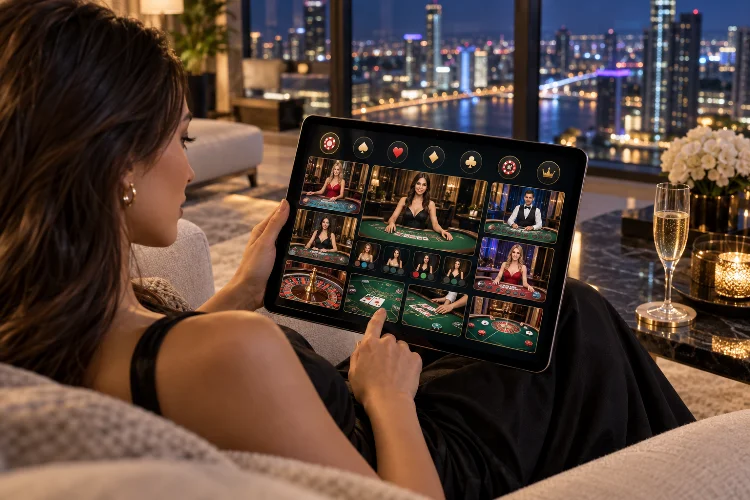
Live Casino Lobby Features Explained: How to Read the Screen
A modern live casino lobby can resemble a streaming app more than an old-fashioned gambling website.
Tables are grouped into rows, personalised suggestions appear automatically, dealers are visible through previews, and filters can instantly shrink hundreds of choices into a short list.
These Live Casino Lobby Features are designed to make game discovery faster, but some labels can be confusing if you do not know what they represent.
From VIP badges and seat counters to game history and mobile layouts, understanding the lobby helps you separate useful information from features that simply influence presentation.
Why Live Casino Lobbies Have Become More Personalised
Large live casino providers now offer enough tables that showing every game in one long list would be impractical.
That has encouraged more sophisticated recommendation and navigation systems.
Evolution confirmed the launch of its Smart Lobby in 2022 as part of its live casino platform development. Earlier and related implementations have featured personalised recommendations, favourites, recently played games, search tools, filters, and previews.
This resembles what streaming platforms do with films or music.
If someone frequently opens roulette, the lobby may place roulette content somewhere more visible. If another user usually selects baccarat, their interface may emphasise that category.
The critical point is that personalisation concerns discovery.
A recommendation does not mean the suggested game has suddenly acquired better odds. It simply means the system believes it may match the player’s preferences.
Table Tiles Contain More Information Than They First Appear
The individual tiles in a lobby are often miniature information panels.
A typical tile may show the game name, dealer, betting range, VIP status, language, game type, or whether a seat is available.
Some platforms also show a live video preview.
Evolution’s earlier Live Lobby development specifically highlighted live snapshots that allowed users to view tables before joining.
The best way to use these cards is to answer practical questions.
Is this the variant you want? Is the minimum stake appropriate? Does it use a language you understand? Is the table currently available?
Try not to turn visual information into a prediction system.
A dealer looking relaxed, a roulette table showing several previous black numbers, or a popular-table badge does not tell you what the next round will produce.
Betting Limits Are One of the Most Useful Filters
If you only check one detail before entering a table, the betting range is a good candidate.
Live casinos can offer dramatically different minimum and maximum wagers.
Evolution describes its portfolio as covering multiple betting levels, including standard tables alongside VIP and high-roller environments.
That is why a minimum-stake filter is useful.
Suppose your preferred stake is $5 per round. A lobby containing tables beginning at $100 provides no practical value to you, regardless of how attractive those tables look.
Filtering by stake removes those options immediately.
Higher limits should not be treated as higher-quality gaming.
They simply allow larger wagers. The underlying house edge depends on the rules and payout structure rather than whether the table is labelled premium.
This is an easy but important seperation to make.
Full Tables and Infinite Tables Work Differently
Seat indicators are particularly important in blackjack.
A traditional live blackjack table typically has a limited number of player positions. When all positions are occupied, new players may need to select another table.
Infinite Blackjack was created specifically to remove this limitation. Evolution describes the product as having unlimited seats, with all participating players initially receiving a common two-card hand before individually deciding how to play it.
This can make lobby labels such as “full” or “seats available” much easier to interpret.
The indicator is not suggesting whether the table is hot, cold, popular for a mathematical reason, or more likely to produce wins.
It is simply communicating capacity.
Some players enjoy the smaller shared-table atmosphere. Others prefer scalable formats because there is no need to wait.
That is a user-experience choice rather than an advantage in predicting cards.
Speed Labels Tell You About Pace, Not Better Odds
Live casino lobbies frequently separate normal and speed versions of games.
A speed baccarat or speed roulette table generally reduces waiting periods so more rounds can take place over the same period.
That may sound like a minor interface difference, but it can significantly change the pace of a session.
A player placing the same amount per round can theoretically put much more money into action over an hour when rounds happen faster.
Therefore, “Speed” should be interpreted as a tempo label rather than a quality badge.
The same logic applies to Deal Now functions or other features designed to reduce pauses.
Faster is not automatically better.
Someone who prefers a relaxed experience may actually find a standard table more suitable.
When comparing two lobby options, think about how session pace could affect your planned entertainment budget rather than simply choosing whichever game reaches the next round sooner.
VIP Labels Describe the Environment and Access Level
A shiny VIP badge can easily look like an indication of superior gameplay.
Usually, it describes the environment instead.
VIP tables may offer higher betting ranges, premium presentation, longer betting periods, smaller player groups, or additional service features.
Pragmatic Play, for example, labels its VIP tables distinctly in the lobby and describes features such as extended betting time and more detailed betting history for its VIP Roulette offering.
Evolution likewise offers VIP and Salon Privé sections within its live portfolio.
None of this automatically means the mathematical return is better.
If two roulette tables use the same wheel format and payout structure, a luxurious studio does not alter those underlying probabilities.
When you see VIP in the lobby, check the table limits and actual rules before deciding whether the premium environment provides anything relevent to you.
Game History Is Descriptive, Not Predictive
Many live tables display recent results.
Roulette might show previous winning numbers. Baccarat may present roadmaps or historical banker and player results. Other games can show previous rounds or betting history.
This information is useful for understanding what already happened.
It becomes problematic when players assume historical sequences must predict the next independent result.
The lobby may make game history visually prominent because players enjoy following the action, but historical presentation is not evidence that a future outcome is “due.”
A run of red roulette results does not automatically mean black is becoming more likely on a fair independent spin.
Similarly, a baccarat roadmap organises past outcomes. It does not guarantee the continuation or reversal of a visible pattern.
Treat history as a record rather than a forecast.
That simple distinction prevents one of the most commom mistakes people make when reading a busy live casino interface.
Dealer and Language Filters Can Make Tables More Comfortable
Language filters are especially useful in international live casino networks.
A player may prefer instructions and dealer interaction in English, Spanish, Portuguese, Italian, or another supported language.
Providers also create localised tables for particular regions.
Evolution’s portfolio has long included localised and native-language live environments, while dedicated tables can be configured around specific brands and markets.
Dealer information serves a similar convenience function.
Some users simply prefer returning to familiar presenters.
However, neither a language nor a favourite dealer should change your understanding of game fairness.
Under UK Gambling Commission standards applicable to regulated live-dealer operations, dealers must be adequately trained, dealing procedures should follow documented game rules, and operations must be fair and independently auditable.
Dealer choice is therefore mainly about the social experience.
Mobile Lobby Design Changes How Features Appear
A desktop lobby has plenty of room for categories, previews, side menus, and table statistics.
Mobile screens do not.
As a result, the same information may appear behind icons, horizontal scrolling rows, expandable filters, or tap-based previews.
Evolution has repeatedly developed its live interface for multiple devices and has introduced portrait-oriented lobby functionality as part of its mobile evolution.
The practical lesson is simple: explore the interface before entering a table.
Find where betting limits, rules, account controls, and filters are located.
Do not assume information is missing simply because it is not immediately visible on the first mobile screen.
Good navigation can take a little learning, particularly when a casino combines several providers in one lobby.
Rules and Payout Information Matter More Than Lobby Ranking
The lobby tells you where a game is.
The rules tell you what it means financially.
UK Gambling Commission technical standards require applicable regulated games to make game rules and information about winning chances or measures such as house edge or RTP easily available before a customer commits to gamble.
That is especially important when several visually similar game variants appear together.
A Lightning-style table, standard roulette table, and another modified roulette game may have very different mechanics.
Never assume that placement near the top of the lobby means a game offers superior value.
Featured positioning can result from popularity, promotion, personalisation, or simple interface design.
Checking the rules takes slightly longer, but it provides far more useful information than the table’s location on the screen.
Live Casino Lobby Features make it easier to navigate a growing range of dealers and tables. Betting filters, seat indicators, game previews, languages, history, VIP labels, and mobile navigation each provide different types of information.
Use the lobby to narrow your choices, but do not mistake recommendations or historical results for better odds. Check the rules, limits, and actual game format before joining any table.