
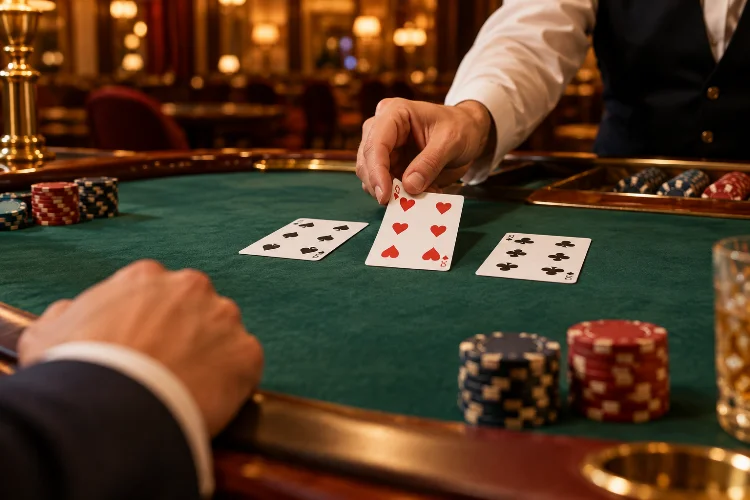
Red Dog Casino Game Explained: Odds, Strategy, and How to Play
Red Dog does not ask you to build poker hands, beat a dealer total, or memorise complicated betting layouts. The entire game revolves around three cards and one question: will the last card land between the first two?
That simplicity makes Red Dog easy to start, but there is still some mathematics hiding underneath.
In this Red Dog Casino Game Explained guide, we will look beyond the basic rules and explore why spreads matter, when raising makes mathematical sense, how payouts compensate for difficult outcomes, and why the number of decks slightly changes the long-term house advantage.
The Goal Is to Land Inside the Gap
Every normal Red Dog round starts with an initial wager and two exposed cards.
The cards follow standard rank order from 2 through Ace, with Ace high, while suits have no value in deciding the result.
Suppose the first two cards are 5 and Jack.
The ranks between them are 6, 7, 8, 9, and 10.
That produces a spread of five.
The player wins if the third card is any of those five ranks. A queen, king, ace, 2, 3, 4, 5, or jack does not qualify.
This makes Red Dog different from poker despite its occasional “Red Dog Poker” nickname. There are no straights, flushes, or conventional poker hand rankings to compare.
Only card rank and the space between the opening cards matter.
Why Small Spreads Pay More
Casino payouts are designed around probability.
When the spread contains only one possible rank, hitting it is relatively difficult. That is why a spread of one traditionally pays 5:1.
A spread of two pays 4:1, while three pays 2:1.
Once the gap reaches four or more ranks, standard rules normally switch to even-money payouts.
Think about two examples.
Cards 6 and 8 create only one winning rank: 7.
Cards 2 and Queen create nine winning ranks: 3 through Jack.
The second setup has many more cards that can potentially produce a winning result, so there is no large payout multiplier attached to it.
This relationship between difficulty and payout is the core matemathical structure of the game.
Consecutive Cards Create an Automatic Push
Opening cards can sometimes leave no valid winning card between them.
If the dealer reveals 10 and Jack, for example, the spread is effectively zero.
Standard casino rules declare the round a tie or push. The wager is returned rather than won or lost. No third card needs to be dealt in this situation.
The push is an important part of the game’s overall mathematics.
It also means that not every Red Dog hand results in bankroll movement.
Beginners sometimes mistake a zero spread for an automatic loss because there is no way to win. In the normal casino version, however, it is simply a neutral round.
The game resets and the next wager begins.
Matching Cards Trigger a Special 11:1 Result
A pair also removes the normal spread, but it is handled differently from consecutive cards.
Imagine the first two cards are both 9s.
The dealer deals a third card automatically.
If another 9 appears, the player receives a traditional 11:1 payout. If the third card has any other rank, the result is a push. BCLC’s published rules specify both the tie for a non-matching third card and the 11:1 payout for three of a kind.
No raise is normally allowed in this situation.
This creates an unusual round where you have a chance at a large payout without making any decision after the first two cards appear.
Because matching the rank is uncommon, however, the dramatic payout should not be confused with a common source of winnings.
When Should You Raise?
This is where Red Dog contains a genuine strategy decision.
After a normal spread appears, the player can usually add a wager equal to the original bet. The question is whether doing so is mathematically sensible.
Wizard of Odds calculates that the extra raise has positive expected value only when the spread is seven or greater. That recommendation holds across the deck counts analysed.
The logic is fairly intuitive.
With a six-card spread, the chance of the third card landing inside the gap is still below the point where an even-money additional wager becomes attractive.
At seven or more, the balance shifts.
So the simple strategy is:
keep the original bet only with spreads of six or less, and make the maximum allowed raise with spreads of seven through eleven.
That does not guarantee the individual raise will win. It simply makes the decision strategicly stronger over repeated play.
A $10 Example Makes the Raise Easier to Understand
Suppose you begin with a $10 wager.
The opening cards are 2 and 10.
Between them sit 3, 4, 5, 6, 7, 8, and 9—a spread of seven.
Under the standard strategy, this is a raising situation.
You add another $10, bringing the total wager to $20.
The third card is 6.
Because the 6 falls inside the spread, the wager wins. A seven-card spread belongs to the even-money payout group, so the $20 total bet generates $20 in winnings, with the original $20 stake also returned.
Now imagine the third card is a queen.
Both the original bet and raise lose.
The raise therefore doubles the amount exposed to that third card. It is not free money; it is an additional wager made when the probability has become comparatively favourable.
How Much Does the House Edge Matter?
The house edge in Red Dog is relatively close to several familiar casino table games, but it changes slightly with deck count.
Using the standard raise strategy, Wizard of Odds reports approximately 3.155% with one deck, 3.077% with two, 2.884% with four, 2.798% with six, and 2.751% with eight decks.
Casino City’s rules summary similarly notes that the edge is around 3% and decreases slightly as additional decks are used.
That does not mean a six-deck player loses exactly $2.80 for every $100 wagered in a session.
House edge is a long-run expectation.
Short sequences can easily finish above or below that average because individual card outcomes fluctuate.
The useful lesson is that deck count has a measurable effect, but it does not turn Red Dog into a predictable game.
Why Raising Every Hand Is a Mistake
The interface can make raising feel attractive because it creates the possibility of a larger win.
But more money at risk is not automatically a better wager.
Imagine a spread of one.
The potential payout is 5:1, which looks exciting, but only one rank between the two opening cards can win. Wizard of Odds calculates the expected value of raising that situation as strongly negative.
The same problem persists through spreads two to six.
The payout changes, but the probability and reward still do not combine favourably enough to justify the additional bet under the standard paytable.
Waiting for seven or more may feel less exciting because those rounds pay only 1:1.
Yet a higher probability of success is what makes the extra wager defensible.
That is a good example of why the largest payout is not always the best betting decision.
Deck Count and Rule Variations Are Worth Checking
Red Dog is simple enough that small rule differences are easy to overlook.
BCLC specifies a four-to-six-deck shoe, while Danske Spil documents an online version using a single standard 52-card deck that is shuffled at the start of each game.
Casino City notes that versions using one, four, five, six, or eight decks have existed.
This means two games with identical graphics may not necessarily have identical mathematics.
Check the rules screen for the deck count, raise conditions, payout schedule, and treatment of pairs.
The standard spread payouts are widely used, but verifying them is still better than assuming every implementation is exactly the same.
A small rule detail can be more relevent than a flashy table design.
Common Beginner Mistakes
The first common mistake is counting the endpoints as part of the spread.
If the cards are 4 and 8, the winning ranks are 5, 6, and 7. The spread is three—not five.
Another mistake is thinking suits matter.
They do not under standard casino Red Dog rules.
Players may also assume an equal third card is “inside” the range. It is not. If the third card matches either opening card during a normal spread, the wager loses.
Finally, some players raise because they just lost several hands and feel a win is due.
Previous rounds do not change the basic value of the current spread. Base the raise decision on the cards in front of you, not the recent history.
Keeping those points seperate makes the game much easier to follow.
This Red Dog Casino Game Explained guide shows that the game is mostly chance, with one small but meaningful decision around raising. The spread controls the payout, pairs create a special 11:1 opportunity, and consecutive cards result in a push.
If you decide to play, verify the exact rules first and use the spread – not recent wins or losses – to understand the decision in front of you.